
A new AGC and NCCER survey says nearly a third of contractors have already felt immigration enforcement on their work. The number that should change your schedule is a different one.
Key Takeaways
- A new AGC and NCCER survey of 1,830 construction firms found 29% have felt an effect from immigration enforcement, but the regional split matters more: 42% in the South versus 17% in the Midwest.
- Construction job openings climbed five straight months to 326,000 in July 2026 while the layoff and quit rates both sat at 1.9%, the signature of firms that cannot find workers rather than firms shedding them.
- Cold weather installs have a hard deadline that ordinary schedule slippage does not. Miss the freeze-up window and the cost is winter conditions work or a spring reschedule, not just a late finish.
- Lock in specialty installers earlier than usual, get subcontractor staffing and documentation in order now, and price labor availability as a schedule risk rather than a line item.
There is a number in the AGC and NCCER workforce survey released this month that should change how you bid the rest of the year, and it is not the one making headlines.
The headline number is 29 percent. That is the share of the 1,830 construction firms surveyed in July and August who reported at least one direct or indirect effect from immigration enforcement. Break it apart and it gets more specific.
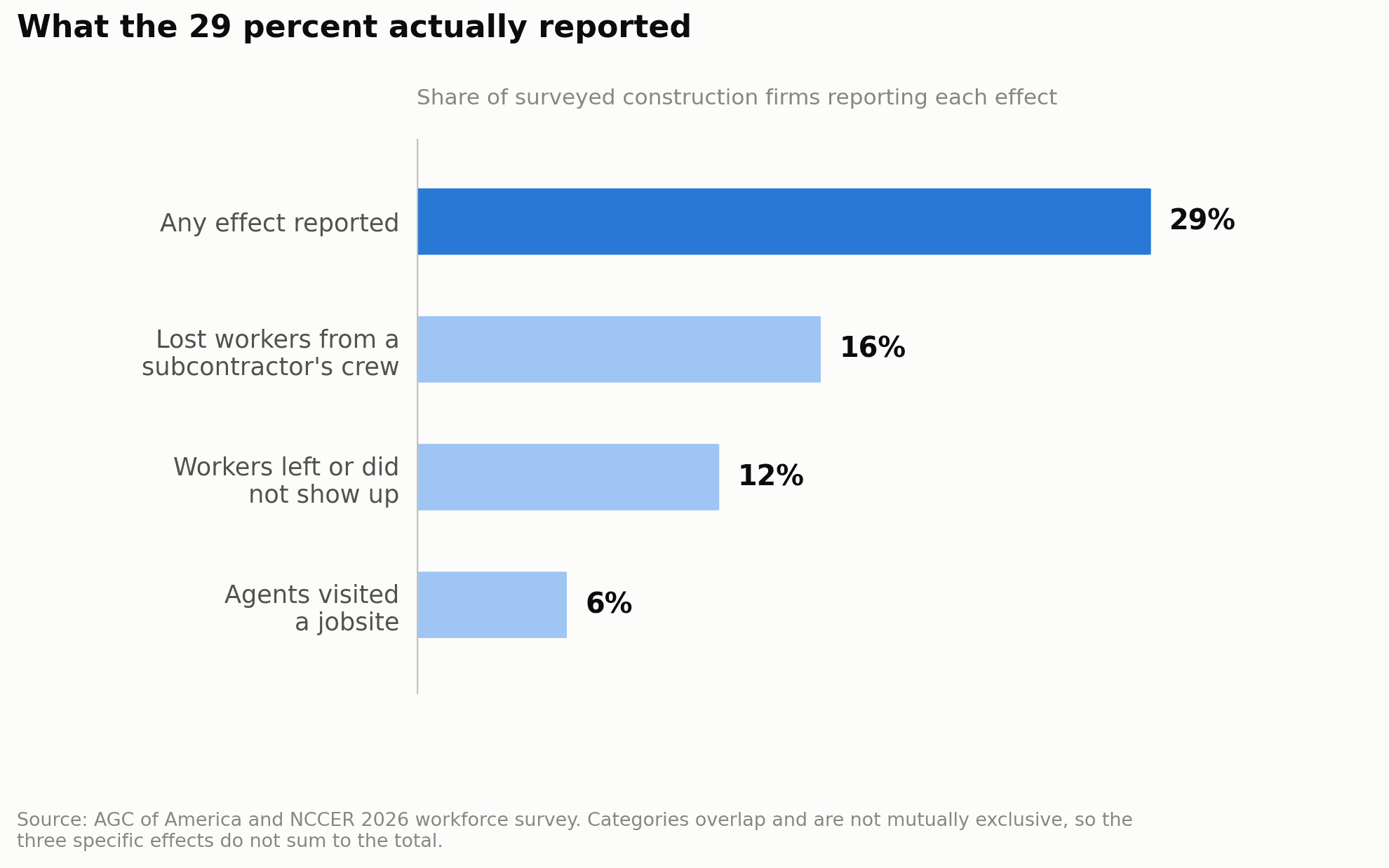
Sixteen percent lost workers off a subcontractor's crew. Twelve percent had workers leave or fail to appear because of enforcement actions, actual or rumored. Six percent had agents visit a jobsite. Those categories overlap, which is why they add to more than 29.
That is the number people are arguing about. The number that should change your schedule is 42.
The Map Matters More Than the Average
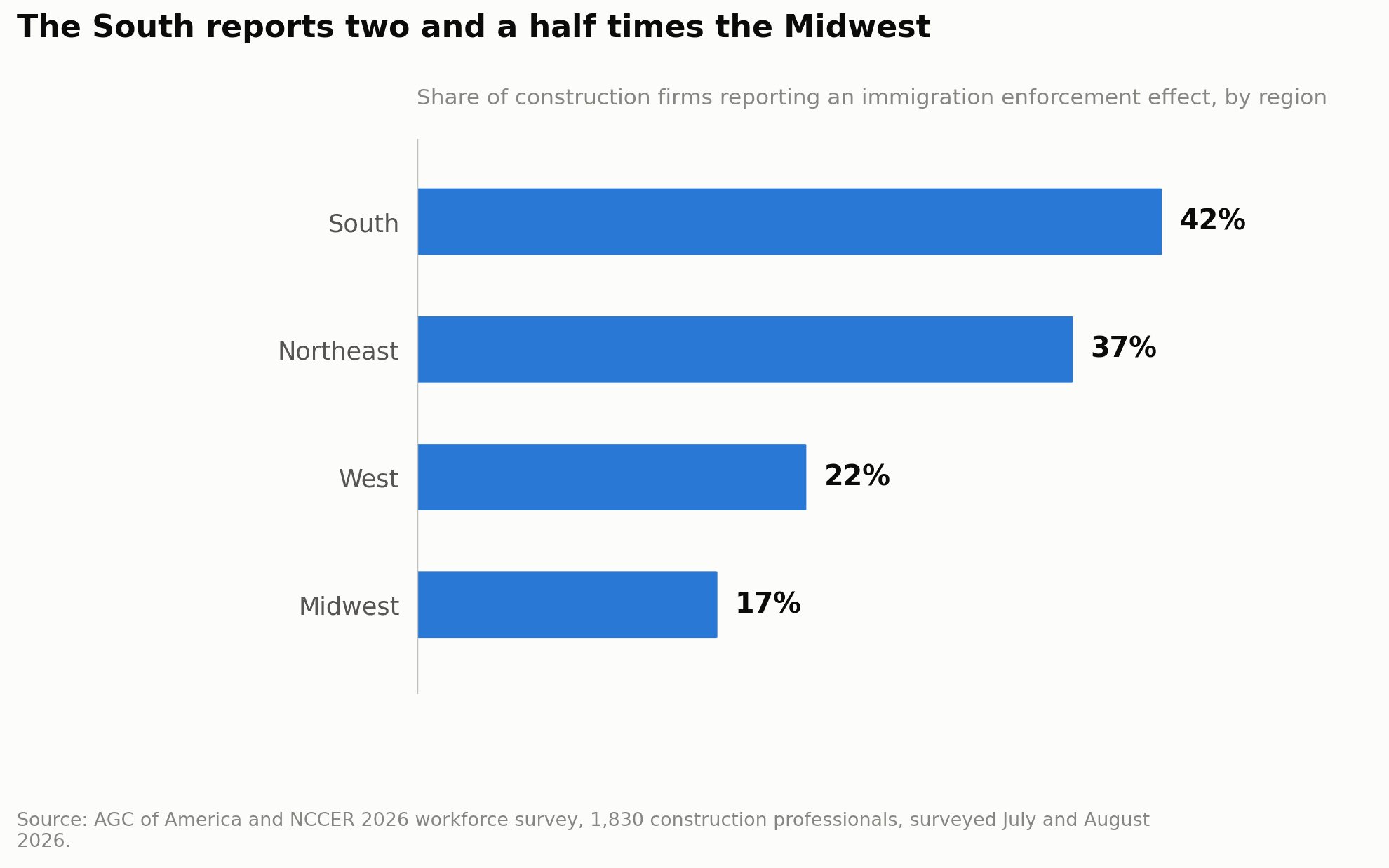
A national average tells you almost nothing useful, because almost nobody builds nationally. If you work the Southeast, the survey is telling you that something close to half your peers have already felt this. If you are in Minnesota or Wisconsin, it is telling you that most of your peers have not, at least not yet.
- South: 42% reporting an enforcement effect
- Northeast: 37%
- West: 22%
- Midwest: 17%
That gap matters most for anyone who moves crews across regions, or who relies on traveling installers for specialty work. The pool you have historically drawn from is not shrinking uniformly. It is shrinking in specific places, and it is shrinking fastest in the region that supplies a lot of the mobile labor the rest of the country borrows.
The Other Half of the Squeeze
Construction job openings bottomed out in February at 201,000. Five months later they hit 326,000, the highest level since August 2024.
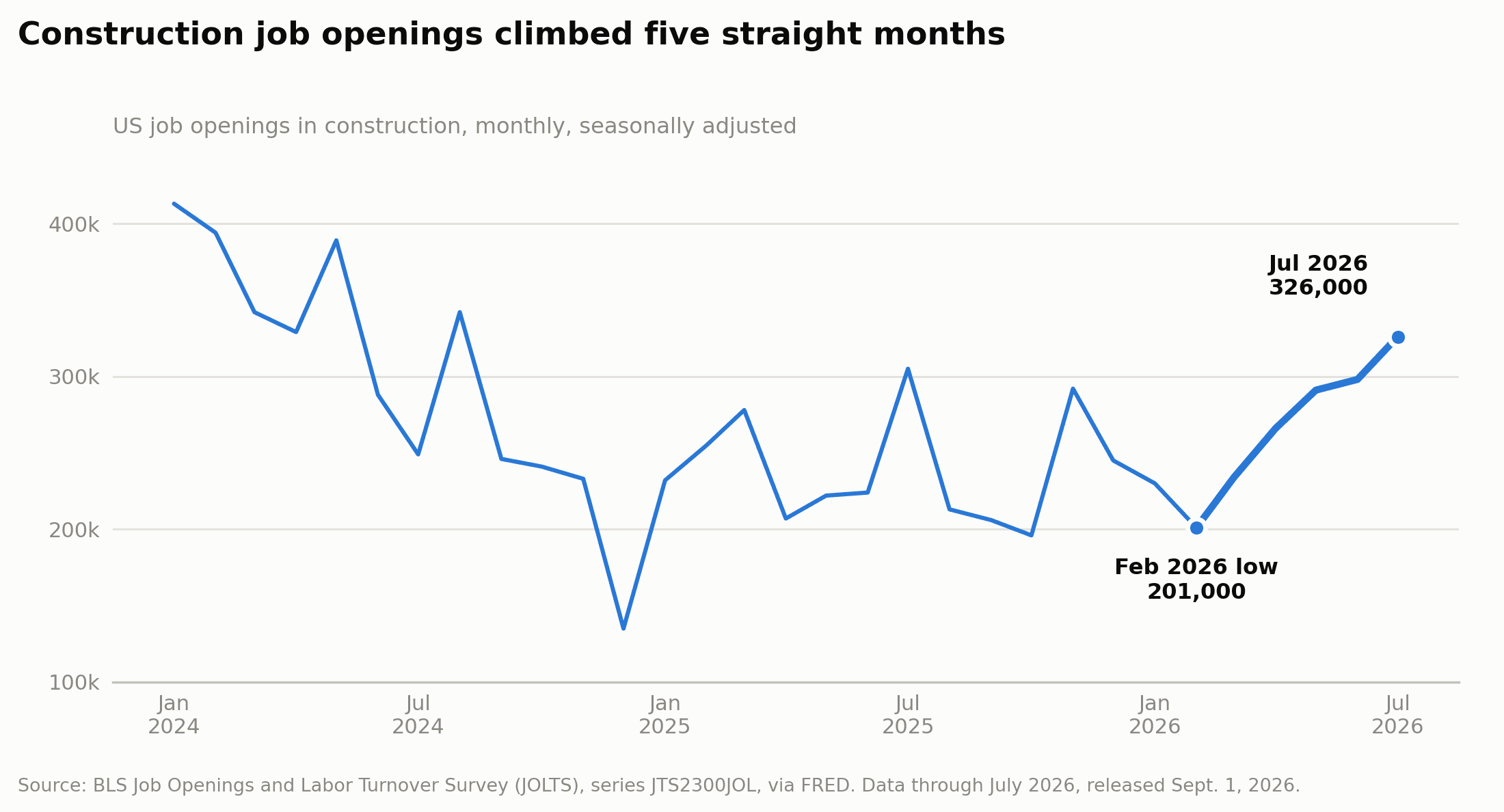
Contractors are not trimming crews. They cannot find them. The layoff and discharge rate and the quit rate both sat at 1.9 percent in July, which is the statistical signature of a labor market where nobody is leaving and nobody is being let go. The openings are not churn. They are unfilled demand.
Associated Builders and Contractors chief economist Anirban Basu credited what he called "insatiable demand for data centers and the accompanying strength in power-related construction." He also offered the warning that matters for anyone planning fall work: "reemerging worker shortages will put upward pressure on labor costs over the next several months."
- Firms with open hourly craft positions: 87%
- Of those, filling as hard or harder than last year: 88%
- Firms reporting shortages are delaying projects: 42%
- Construction layoff and discharge rate, July 2026: 1.9%
- Construction quit rate, July 2026: 1.9%
Put the two datasets side by side and the picture is simple. Demand for craft labor is climbing. Availability is under pressure from a second direction at the same time.
Why This Hits Cold Weather Work Harder Than Anything Else
Most construction schedule risk is elastic. A job slips two weeks, everybody grumbles, the work gets done.
Cold weather work is not elastic. A metal roof, a retention retrofit, anything that has to be installed before the deck ices and the crew cannot safely be up there, has a hard wall at the end of it. Miss the window and you are not two weeks late. You are looking at winter conditions premiums, temporary protection, or a spring reschedule that pushes revenue into the next fiscal year.
Here is the arithmetic worth running for your own operation. Take a typical fall install. Add two weeks of installer delay. Now price the remobilization, the winter conditions work, and the carrying cost of material sitting on the site.
The point of the exercise is not the number. It is that most contractors have never actually calculated it, which is why labor availability keeps getting treated as a scheduling inconvenience rather than a priced risk.
What to Actually Do About It
- Lock installers earlier than feels necessary. If your fall work depends on a specialty crew, the time to secure them was August. The time to secure them for next fall is now.
- Get your documentation in order before someone else looks at it. I-9 files, subcontractor certifications, whatever your jurisdiction requires. This is basic hygiene that a lot of firms have let drift, and drift is expensive at exactly the wrong moment.
- Ask your subs the uncomfortable question. Sixteen percent of the reported effects came through a subcontractor's crew, not the general's own payroll. Your exposure runs through people whose staffing you do not control and usually do not ask about.
- Price labor availability as a risk, not a line item. Escalation clauses help with cost. They do not help with a crew that does not exist. Schedule float is the only real hedge, and float has to be negotiated at bid time, not discovered in October.
The Part Everyone Skips
AGC chief executive Jeffrey Shoaf framed it this way: "The goal should be to enforce the nation's immigration laws while also recognizing the very real workforce needs of industries like construction that are essential to the economy."
Reasonable people land in different places on the policy. You can hold almost any view on immigration enforcement and still have to answer the operational question, which is who is going to install the work you sold. That question does not resolve itself while the argument continues.
Sources
- AGC of America and NCCER 2026 workforce survey, 1,830 respondents, surveyed July and August 2026. Reported by Roofing Contractor, September 3, 2026.
- BLS Job Openings and Labor Turnover Survey, July 2026 data, released September 1, 2026. Series JTS2300JOL via FRED.
- ABC commentary on the JOLTS release, via NRCA Roofing News, September 3, 2026.
Ready to plan a project?
Estimate Your Snow Retention System
Use the ArcticAnchor™ calculator to review a system layout, or request a quote directly from our team.